Wednesday, October 21, 2026
HomePlants & AnimalsBiologyChemistryClimateSolar SystemExtrasolar PlanetsRSS Feed
Search the archive
Physics

The possibilities for dark matter have just shrunk — by a lot 

Scientists have just slashed the potential hiding spaces for dark matter particles. The LUX-ZEPLIN, or LZ, experiment has searched for and ruled out the existence of dark matter particles with a wide swath of properties, researchers…


The possibilities for dark matter have just shrunk — by a lot 
science

Editor's note: This article summarises published research for a general audience. It is not medical, legal or professional advice — check the primary sources before acting on it.

Scientists have just slashed the potential hiding spaces for dark matter particles.

The LUX-ZEPLIN, or LZ, experiment has searched for and ruled out the existence of dark matter particles with a wide swath of properties, researchers report August 26 at two conferences. Dark matter is a substance whose influence can be seen on the scale of galaxies and galaxy clusters, but which has never been directly detected. 

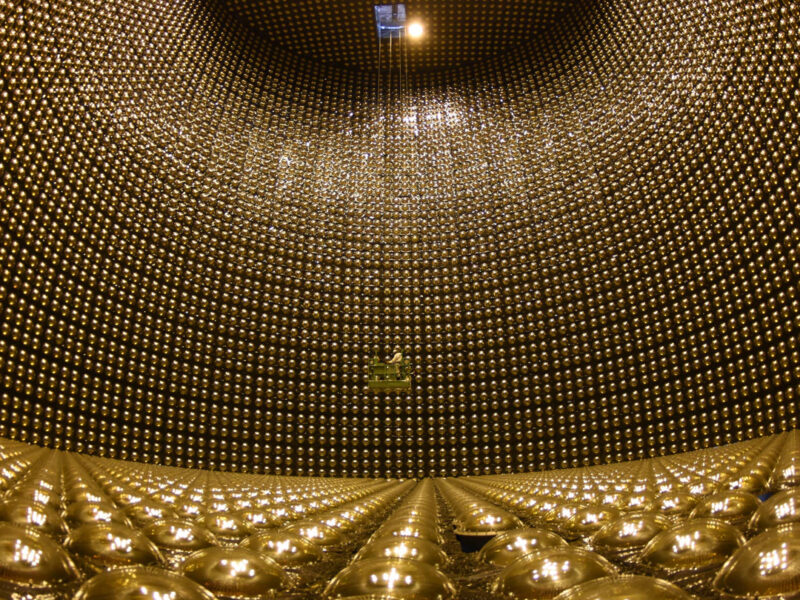
LZ searches for a hypothetical type of dark matter particle called a weakly interacting massive particle, specifically WIMPs with masses above 9 billion electron volts. (For comparison, a proton has a mass of around 1 billion electron volts). The LZ detector, filled with 10 metric tons of liquid xenon, monitors for atomic nuclei recoiling when WIMPs plow into the liquid (SN: 7/7/22). 

The researchers characterize WIMPs by their cross section — the probability that a particle will interact. The result shrinks the maximum possible cross section to about a fifth that allowed by previous results, LZ researchers report at the TeV Particle Astrophysics meeting in Chicago and at the Light Detection in Noble Elements meeting in São Paulo.

“We are making massive strides into new territory,” says physicist Chamkaur Ghag of University College London, spokesperson of LZ. 

The study was performed with 280 days’ worth of data. LZ’s final results will be based on 1,000 days of data, and it’s expected to further carve away at the dark matter’s possibilities — or find evidence of it.

Written by

admin

Writes about research and discovery for this publication.